I came to Iceland on a budget.
I did the research, booked things in advance, planned the tours, and packed warm clothes. I thought I was ready for 3 days in Iceland in winter and my first proper winter trip to the country.
Then my flight got diverted in a blizzard.
That was my first introduction to Iceland. Not a calm arrival. Not a picture-perfect landing with the snowy mountains glowing in the distance. Just a plane full of confused passengers, a sudden U-turn, a stop in Inverness, and a journey that should have taken around three hours, turning into nearly eight.
By the time I finally landed at Keflavik Airport, it was freezing. Not London cold. Not “put on a jacket” cold. I mean the kind of cold where the air feels like you have opened a freezer and stepped inside it. And because my flight was delayed, I missed my pre-booked transfer and ended up paying around £140 just to get from the airport to my hotel.
So let me say this from the beginning: Iceland in winter is beautiful, but it is not easy. It is expensive, unpredictable, freezing, slippery, dramatic and at times, it will test your patience.
But is it worth it spending 3 days in Iceland in Winter?
After exploring Reykjavik, the Golden Circle, the South Coast, glaciers, waterfalls, black sand beaches and the Northern Lights, my honest answer is ‘YES’ in capital letters, but you need to know what you are getting yourself into.
Day 1: Reykjavik in Winter
My first full day started in Reykjavik, and I think this is a good place to begin if you are visiting Iceland for the first time. It gives you a slower introduction to the country before you start heading out into the wild landscapes.
I stayed at Arctic Comfort Hotel, slightly outside the main city centre, so I took the local bus into town. You need to download the Klappið app for public transport, and for me, that was one of the first practical lessons. Iceland is expensive, so any chance to avoid taxis is worth taking.
The walk to the bus stop was only a few minutes, but already I was surrounded by a complete blanket of snow. Cars were being cleared, pavements were icy, and the whole city had this stillness to it. As someone from London, where snow rarely settles properly, it honestly felt like a privilege just to be walking through it.
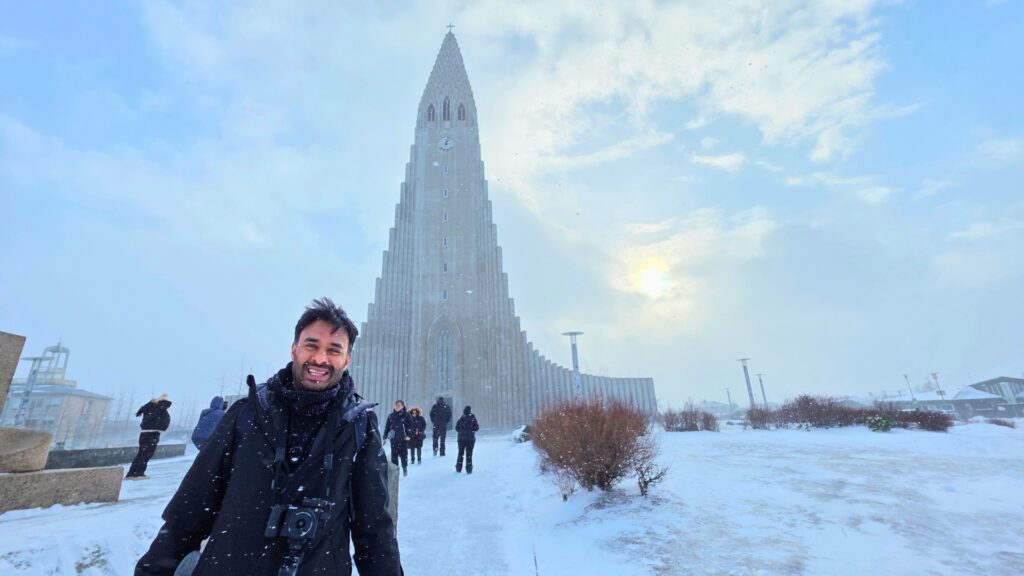
The first major stop was Hallgrímskirkja Church. I butchered the pronunciation several times, and I will not pretend otherwise. Icelandic names are not easy, but that is part of the fun. The church itself is stunning, with its design inspired by Iceland’s volcanic landscape. It stands tall over the city, and because Reykjavik is not packed with skyscrapers, you can see it from so many different angles.
Inside, it is peaceful and simple, but the organ is huge. Outside, it becomes the perfect starting point for a walking route through the city.
Right next to the church is the Einar Jónsson Sculpture Garden, which is free to enter. This is a quick but worthwhile stop, especially if you are already in the area. Reykjavik is not a city where every corner is packed with huge tourist attractions, so my advice is to enjoy the smaller stops too. The sculpture garden, the streets, the cafes, the little moments of walking through snow — that is where the city starts to work.
From there, I walked down Rainbow Street, one of the most photographed streets in Reykjavik. It gives you that classic view looking back towards Hallgrímskirkja, and yes, it is touristy, but it is still worth seeing. The colourful street against the white winter snow gives the city a bit of life and character.
But let me be honest: Reykjavik in winter is cold. Your fingers burn. The snow comes down suddenly. One moment you are fine, the next you are desperate to step into a cafe just to warm up. That is why I popped into places like Hard Rock Cafe, not because I planned it, but because sometimes you need warmth more than anything else.
From Rainbow Street, I headed towards Harpa Concert Hall. The glass design is beautiful, reflecting the sea, sky and colours of Iceland. Then I walked along the waterfront towards the Sun Voyager, which for me was one of the most meaningful stops in the city. It looks like a Viking ship, but it is actually a symbol of hope, exploration and discovery.
That message hit me. Because travel is not just about ticking off places. It is about stepping into the unknown, getting uncomfortable, and sometimes finding something in yourself while discovering somewhere new.
That evening, I joined a Northern Lights tour. This is one of those things you cannot control. You can book the tour, wrap up warm and travel out into the darkness, but there is no guarantee the lights will appear.
We drove out for around an hour, stood in the pitch black, waited, looked at the sky and hoped. What surprised me most is that the Northern Lights do not always look to the naked eye like they do in photos. Sometimes what you see is a faint grey or green line, while the camera picks up far more colour because it holds the light for longer.
But when that faint green light appeared, even softly, it still felt special. It was not the dramatic Instagram version. It was quieter than that. More real. And maybe that is why I appreciated it.
Day 2: The Golden Circle in Winter
If Reykjavik is the slow introduction, the Golden Circle is where Iceland starts showing off.
This route is one of the best things to do in Iceland in winter because it gives you so much variety in one day: history, geology, geothermal activity, waterfalls and volcanic landscapes.
The first stop was Þingvellir National Park, and honestly, the bus journey there alone was one of the most scenic journeys I have ever taken. Snow everywhere. Open landscapes. Mountains in the distance. That feeling of finally understanding why Iceland is called the land of ice and fire.
At Þingvellir, the snow was deep, the paths were slippery, and the views were surreal. This is where you are walking between the North American and Eurasian tectonic plates, which makes it one of the most geologically unique places in the world.
But beyond the facts, it was the feeling that stayed with me. Walking down towards the canyon, seeing frozen water, snow-covered rocks and people moving carefully across the icy paths — it makes you pause. You get that “am I really here?” feeling.
One practical tip: wear sunglasses if the sun is out. The reflection from the snow can be intense. And wear boots with grip, because in winter, even simple walking routes can feel like a mini hike.
From Þingvellir, we went to the geothermal area to see Strokkur erupt. This was one of the most exciting stops of the day because everyone gathers around waiting for the same moment. You see the water bubbling, steam rising, the crowd getting quiet, cameras ready — and then suddenly, boom, it blasts into the air.
It is quick, powerful and unpredictable. The anticipation makes it even better.
You also get that sulphur smell in the air, like rotten eggs, which is part of the geothermal experience in Iceland. Even in the hotel, when the hot water came through, you could smell it. That is the reality of Iceland — beautiful, but raw.
Next was Gullfoss, one of Iceland’s most famous waterfalls. You hear it before you properly see it. Then the canyon opens up, the water crashes through the landscape, mist rises, and every step closer makes your jaw drop a little more.
This is not just a photo stop. It is a place where you stand there and feel the scale of nature. The sound, the cold air, the mist on your face — it is powerful.
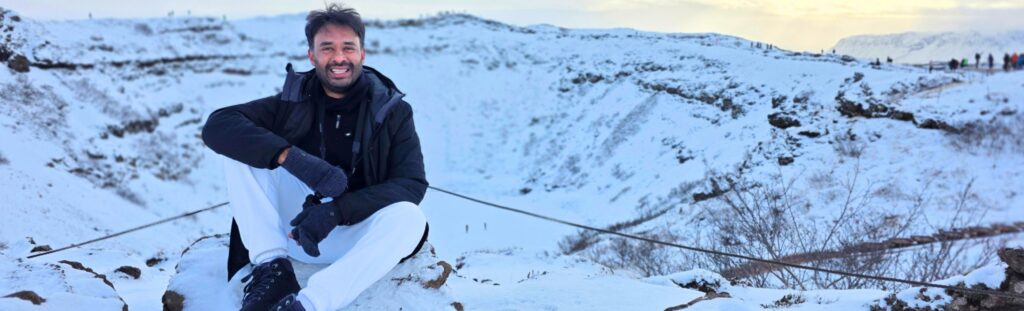
The final stop was Kerið Crater. In other seasons, you can see more of the red volcanic rock, but in winter it was covered in snow, giving it a completely different atmosphere. I walked down into the crater, and there is something crazy about being able to say you stood inside what used to be a volcanic site.
For me, the Golden Circle was worth it. I paid around £61 for the tour, and considering it was a full day of moving from one major natural wonder to another, I thought that was one of the better-value experiences in Iceland.
You can book the exact tour I did via Get Your Guide: https://getyourguide.tpx.li/B5kdBspq
Day 3: Iceland’s South Coast and Glacier Hiking
The South Coast was the most adventurous day of the trip.
This is the day where Iceland goes from beautiful to wild.
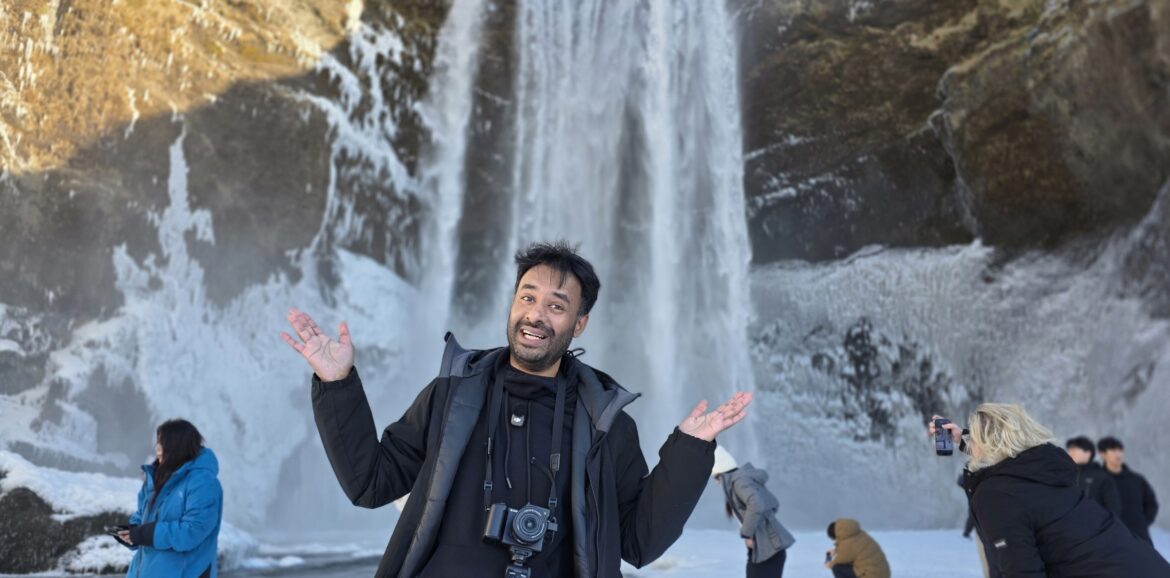
The first stop was Skógafoss, one of the most powerful waterfalls in Iceland. You can walk up the stairs to the viewpoint, but I chose to experience it from the bottom. And I stand by that decision.
To truly feel a waterfall, you need to stand near the force of it. You need the mist blowing onto you, the sound thundering in your ears, the water crashing down in front of you. The ground was icy and slippery, so I could not get as close as I wanted, but even from a safe distance, it was sensational.
On a sunny day, you might see a rainbow forming in the mist. That moment alone makes the visit worth it.
Then came the biggest highlight of the whole trip: glacier hiking.
Helmet on. Crampons on. Axe in hand. Standing on a sheet of ice.
This was one of those pinch-yourself moments.
I will be honest, getting into the gear was not smooth. I struggled with the harness, struggled with the crampons, and there were moments where I thought, “What am I doing here?” But once the hike began, everything changed.
Walking across the glacier felt challenging but not impossible. You have to trust the guide, follow the path, dig your feet in, and take it step by step. There were icy patches, small climbs, a tunnel-like section, and moments where the scenery just opened up around us.
What I loved most was the sense of challenge. Travel should not always be comfortable. Sometimes the best memories come from doing something that pushes you slightly beyond what you are used to.
Glacier hiking gave me that feeling.
After the glacier, we headed to Reynisfjara Black Sand Beach. This is one of Iceland’s most iconic places, and it feels completely different from everywhere else. The black volcanic sand, basalt columns, cave, and powerful Atlantic waves create a scene that feels raw and dramatic.
But this is also a place you must respect. The waves are extremely strong, and you can see why people are warned to keep their distance. This is not a beach for playing around near the water. It is a place to stand back, take in the view, and respect the power of nature.
There are no rides, no theme park, no entertainment built around it. Just nature demanding your attention.
The final stop was Seljalandsfoss, the waterfall famous because in the right season you can walk behind it. In winter, the path behind was closed because of ice, so I could only see it from the front. Was that disappointing? A little. But even from the front, it was still stunning.
The drop, the mist, the rainbow, the frozen surroundings, it was a beautiful way to end the day.
For this South Coast experience, I paid just over £120, which included glacier hiking, waterfalls and the black sand beach. Iceland is expensive, no doubt about that, but this was one of those experiences where I felt the money was worth it.
You can book the exact tour I did via Get Your Guide: https://getyourguide.tpx.li/bafwje3H
My Iceland Winter Travel Guide: What I Would Tell Anyone Planning Iceland in Winter
First, pack food and drinks. I cannot stress this enough. Iceland is expensive, especially if you are buying food throughout the day. I brought packed food from the UK, made lunches, carried drinks, and that saved me a lot of money.
Second, book tours in advance, especially if you do not drive. If you cannot rent a car, day tours are probably the easiest way to see the Golden Circle and South Coast. They take the stress away and allow you to see multiple locations in one day.
Third, dress properly. Not just a jacket. You need layers, gloves, hat, warm socks and proper shoes. The cold can bite, and icy paths can be dangerous if you do not have grip.
Fourth, do not expect everything to go perfectly. Flights can be delayed. Weather can change. Paths can close. Northern Lights might not appear. Winter Iceland is unpredictable, and that is part of the experience.
Finally, do not just chase photos. Iceland is one of those countries where the feeling matters more than the picture. The sound of Gullfoss. The cold air at Þingvellir. The silence before the Northern Lights. The fear and excitement of stepping onto a glacier. The waves crashing at Reynisfjara.
That is the real Iceland.
Raw. Expensive. Freezing. Beautiful. Unpredictable.
And absolutely worth experiencing at least once.
So if you are planning a short 3 days in Iceland in winter trip, I would recommend this route: one day in Reykjavik, one day on the Golden Circle, and one day on the South Coast with glacier hiking.
It gives you a powerful mix of culture, landscape, adventure and those once-in-a-lifetime moments that stay with you long after the trip is over.
This is Iceland.
And honestly, what an experience. Below I share a full 3 Day Iceland Itinerary which will help you plan the exact things you can do during your trip.